
Northern Colorado is entering a new phase of regional competition. For decades, Fort Collins has been the primary economic and employment hub of the region, supported by Colorado State University, a strong base of professional and technical jobs, and a high quality of life that consistently attracted new residents. Greeley, historically more industrial and blue-collar in character, is now emerging as one of the fastest-growing metropolitan areas in the state. Looking forward, the economic trajectories of these two cities are diverging in meaningful ways, shaped by population trends, housing costs, labor markets, and deliberate policy choices around business attraction and retail development.
This analysis examines how Fort Collins is positioning itself for the future compared to Greeley, with a focus on economic development strategy, retail competitiveness, and demographic momentum.
A Shifting Demographic and Migration Landscape
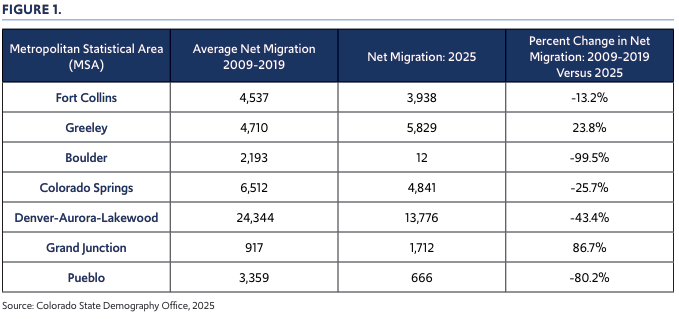
Fort Collins continues to grow, but at a slower pace than in the past. Net migration into the Fort Collins metropolitan area has declined compared to pre-2020 levels, reflecting broader statewide trends as Colorado’s growth moderates. Projections show a short-term rebound in migration through the mid-2020s, followed by a gradual decline toward 2050. While this still represents positive growth, it signals a transition from rapid expansion to a more competitive environment where retaining residents and workers becomes as important as attracting them.
Greeley, by contrast, has experienced stronger recent net migration than its historical average. Projections indicate that the Greeley metropolitan area is expected to surpass Fort Collins in total population as early as 2026, with the gap widening significantly over the coming decades. By mid-century, Greeley could have roughly 100,000 more residents than Fort Collins, fundamentally reshaping the balance of population in Northern Colorado.
Housing affordability plays a central role in this shift. Fort Collins has seen sharp increases in both home prices and rents over the past decade, with average rents surpassing those in the Denver metropolitan area in early 2025. Home prices in Fort Collins are also higher than in nearby markets, including Greeley. Greeley offers relatively more affordable housing, making it attractive to younger households, blue-collar workers, and families priced out of Fort Collins. These cost pressures influence where workers choose to live, even when employment opportunities remain concentrated elsewhere.
Employment Roles: Importer vs. Exporter of Labor
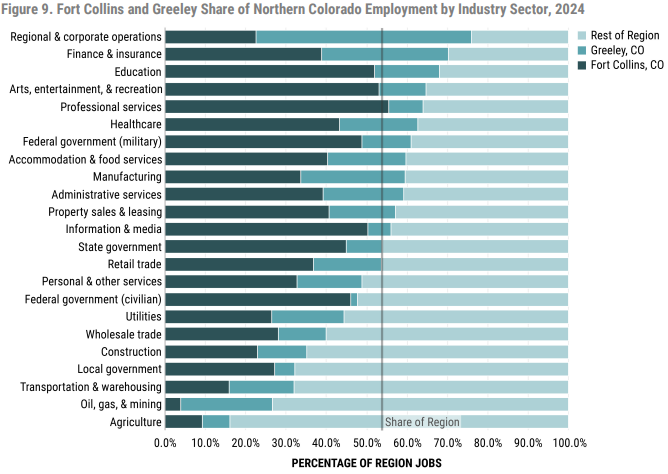
Fort Collins remains the dominant employment center in Northern Colorado. Approximately one out of every three jobs in the region is located in Fort Collins, and the city functions as a net importer of labor, with tens of thousands of workers commuting into the city each day. Its economy is weighted toward higher-wage, white-collar employment categories, including professional services, education, healthcare, and technology-related sectors.
Greeley’s labor profile is different. The city and surrounding Weld County have a higher concentration of blue-collar employment, particularly in manufacturing, construction, logistics, and energy-related industries. While average wages in Larimer County remain higher than in Weld County, Greeley’s lower cost of living can offset some of this wage gap for workers. Importantly, Weld County is the only county in Colorado currently experiencing a rising birth rate, giving Greeley a stronger long-term demographic foundation for workforce growth.
This contrast underscores a key regional dynamic: Fort Collins generates and hosts many of the region’s jobs, while Greeley increasingly supplies population growth and workforce entrants. Over time, this imbalance creates both opportunities and vulnerabilities for Fort Collins if employment growth does not keep pace with housing costs and labor availability.
Fort Collins’ Strategic Pivot on Economic Development
Recognizing these shifts, Fort Collins is actively reevaluating its economic development toolkit. The city’s existing business assistance policies were designed in an earlier era, when land availability, housing affordability, and regional competition looked very different. Since 2015, Fort Collins has not meaningfully used its traditional incentive tools, in part because changes in state tax law and local fiscal structures have reduced their effectiveness.
Meanwhile, neighboring communities—including Greeley—have adopted more aggressive and flexible incentive programs. These communities routinely offer sales tax rebates, fee waivers, expedited review processes, and direct cash incentives to attract and retain employers. As a result, Fort Collins faces increasing competition not only from other states, but from nearby municipalities actively courting the same businesses.
In response, Fort Collins is moving toward an updated, more integrated approach to economic health. The city’s emerging strategy emphasizes:
- Modernized, performance-based incentives aligned with current market realities.
- Support for primary employers that bring net new dollars into the community.
- Coordination between economic development policy and land use planning.
- A renewed focus on competitiveness within the Northern Colorado region.
The goal is not simply growth for growth’s sake, but targeted investment that supports job creation, upward mobility, and long-term fiscal sustainability.
Retail: The Front Line of Fiscal Competition
Retail development is where the divergence between Fort Collins and its regional peers is most visible. Sales tax is Fort Collins’ primary discretionary revenue source, making retail performance critical to the city’s financial health. Yet over the past 15 years, Fort Collins has added far less new retail space than nearby communities.
While Fort Collins added roughly 90,000 square feet of retail and commercial space during this period, communities along the Interstate 25 corridor—such as Johnstown, Timnath, Windsor, and Loveland—added several times that amount. These locations benefit from highway visibility, easier access, and proactive incentive strategies that attract regional and destination-oriented retail.
As a result, Fort Collins has lost some of its regional retail draw. Sales tax growth within the city has remained positive, but much of that growth has been driven by e-commerce rather than brick-and-mortar expansion. Several traditional retail categories have underperformed, signaling leakage of in-person retail spending to surrounding communities.
Greeley, supported by Weld County’s rapid population growth and more development-ready land, has been better positioned to capture new retail investment. As Greeley’s population expands, its retail base is likely to follow, reinforcing its economic momentum.
Fort Collins’ Retail Strategy for the Future
To address these challenges, Fort Collins is developing a proactive retail strategy grounded in place-based investment. Rather than competing uniformly across all retail types, the city is focusing on where retail investment delivers the greatest community and fiscal benefit.
The strategy identifies three primary retail environments:
- Regional Nodes – Large, established centers such as Downtown Fort Collins and Front Range Village that drive citywide and regional sales tax.
- Neighborhood Centers – Grocery-anchored centers that support daily needs and align with the city’s 15-minute city goals.
- Neighborhood Strips and Nodes – Smaller, locally oriented retail areas with limited regional fiscal impact but important roles for small businesses.
Fort Collins plans to concentrate incentives on regional nodes and neighborhood centers, using performance-based, time-limited sales tax sharing tools tied exclusively to new revenue generated by a project. This approach is designed to catalyze reinvestment in aging centers, reduce sales tax leakage, and restore regional competitiveness without undermining fiscal discipline.
The city also recognizes the importance of capturing future retail demand generated by new housing growth, particularly in the northeast portion of Fort Collins. Planned communities in this area are expected to support new neighborhood centers, while the city is also exploring opportunities for a highway-adjacent regional retail site to better compete with I-25 corridor development outside city limits.
Greeley’s Momentum and Fort Collins’ Response
Greeley’s trajectory reflects a different set of advantages: faster population growth, lower housing costs, a growing industrial and manufacturing base, and a demographic profile that supports long-term workforce expansion. These factors position Greeley to continue attracting residents and employers, particularly those sensitive to cost and space constraints.
Fort Collins, however, retains significant strengths. Higher average wages, a concentration of primary employers, a skilled workforce, and a strong quality of life remain powerful assets. The city’s challenge is translating these advantages into sustained economic competitiveness as regional conditions evolve.
The emerging policy direction in Fort Collins suggests an acknowledgment that past success does not guarantee future dominance. By modernizing its business assistance tools, adopting a more assertive retail strategy, and integrating economic development with land use planning, Fort Collins is attempting to shift from a reactive posture to a proactive one.
Conclusion: Two Cities, Two Paths
The future of Northern Colorado will be shaped by the interplay between Fort Collins and Greeley. Greeley’s rapid growth and affordability are redefining the region’s population center, while Fort Collins is working to reinforce its role as the primary employment and economic engine.
The outcome is not a zero-sum game, but it is competitive. Fort Collins’ ability to attract businesses, retain workers, and capture retail spending will depend on how effectively it implements its updated economic and retail strategies. As population growth disperses and regional competition intensifies, deliberate policy choices—rather than momentum alone—will determine whether Fort Collins can maintain its economic leadership in the decades ahead.