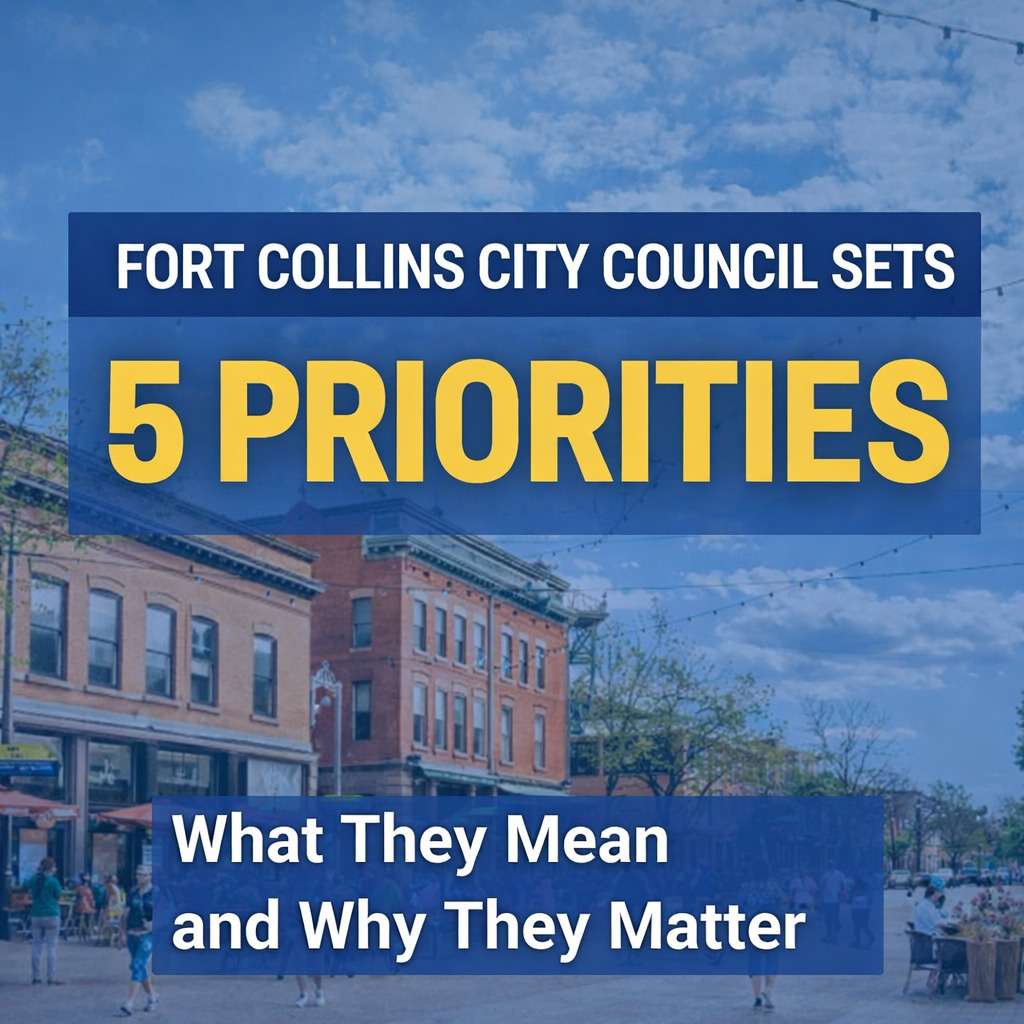
Five Clear Priorities. A Sharper Focus. And Big Implications for Housing, Affordability, and Growth.
On November 4, 2025, Fort Collins voters elected a new City Council. On January 13, 2026, they were officially sworn in. And on February 10, during a public work session, they laid out the foundation for what they want to accomplish over the next two years.
If you care about housing affordability, development timelines, local business growth, infrastructure, or even how the City communicates with residents — this matters.
On March 3, Council will consider formal adoption of their 2026–2027 priorities alongside the 2026–2030 Strategic Plan (outlined in the February 10 Work Session agenda and materials). But the direction is already clear.
The biggest headline?
They narrowed everything down to five primary priorities — a significant reduction meant to create focus, accountability, and measurable outcomes.
Let’s walk through what they are, what they mean, and why they matter.
Ensure Long-Term Financial Sustainability
Originally titled “Financial Sustainability & Efficiency,” this priority centers around something simple but critical: making sure Fort Collins can continue to provide services and infrastructure without overextending itself financially.
The City is facing:
- Rising operational costs
- Aging infrastructure
- Economic uncertainty
- Long-term capital improvement needs
This priority includes:
- Modernizing financial systems (including a new Enterprise Resource Planning (ERP) system)
- Transitioning to multi-year budgeting
- Conducting program inventories
- Aligning service levels with long-term financial capacity
- Developing an integrated Capital Improvement Plan
Timeline highlights (2026–2027):
- ERP governance and project management underway in 2026
- Budget methodology transition in progress
- Integrated citywide Captial Improvement Plan development beginning in 2027
Why this matters:
Financial sustainability is directly connected to affordability. If the City can operate more efficiently and align services with realistic revenue, that helps stabilize fees, utilities, and long-term tax pressure.
Nearly every conversation during the work session had some housing or affordability undertone — and this priority is foundational to that.
Connect Community to Council Actions
Originally called “Sharing Council actions more broadly,” this priority focuses on transparency and communication.
Council members openly discussed the need to:
- Improve digital communication
- Expand outreach beyond social media
- Host listening sessions
- Create clearer meeting recaps
- Potentially modernize how policy decisions are communicated
There was even lighthearted discussion about creative outreach approaches — including influencer-style strategies — while also recognizing the importance of reaching residents who are not on social media.
Planned actions include:
- A “City in :60” video series
- Digital media audit and messaging strategy
- Focus groups on preferred communication methods
- Quarterly priority updates
Why this matters:
Policy decisions only work when residents understand them. Whether it’s development rules, safety initiatives, or budget changes — better communication builds trust.
And in a city as engaged as Fort Collins, clarity matters.
Make Development Predictable, Efficient, and Cost-Effective
(Originally: “Reduce barriers to make it easier to build”)
This was the most discussed priority of the evening — and arguably the most impactful.
The goal:
Remove regulatory friction, reduce processing times, simplify systems, and make development more predictable and cost-effective.
The work plan includes:
- Rebuilding Development Services
- Reducing review rounds
- Code updates for infill and redevelopment
- Creating clearer pathways for greenfield and neighborhood infill
- Aligning City Plan and Climate policies
Success metrics will include:
- Processing time reductions
- Fewer review rounds
- Housing unit totals and diversity
- Customer satisfaction
- Investment in activity centers
The Affordability Conversation
Almost every part of this discussion tied back to housing affordability.
Councilmember Chris Conway suggested using a median income-to-home-price ratio of 3:1 as a target metric.
To put that into perspective:
If median income is roughly $120,000 and median home price is $620,000, we’re closer to 5:1 today.
To achieve 3:1:
- Home prices would need to fall dramatically
- Incomes would need to rise substantially
- Or some combination of both
Is it aspirational? Yes.
Is it realistic in the near term? That’s a tougher question.
I appreciate setting bold goals — but I also believe metrics should be achievable and grounded in economic reality. A 40% reduction in pricing or massive income growth is not simple policy work.
That said, reducing friction, time, and uncertainty in development absolutely can help stabilize housing costs over time.
This is a major one to watch.
Bolster Economic Vitality
(With a focus on neighborhood centers and quality job creation)
A strong economy underpins everything else.
Council discussed:
- Recruiting “primary employers” (businesses that export goods/services and import capital into the community)
- Supporting small businesses
- Activating neighborhood centers
- Modernizing business assistance programs
- Expanding the creative and nighttime economy
A key clarification during discussion:
Primary employers are not just large corporations. Nearly 90% of Fort Collins businesses are small businesses, and small businesses can absolutely qualify as primary employers.
The timeline includes:
- Business retention and expansion
- Site readiness assessments
- Retail strategy
- Barriers-to-business analysis
- Creative/nighttime economy activation
Why this matters:
Economic vitality directly influences income growth and also sales tax revenue — which ties back to housing affordability. You cannot solve affordability without income growth and you’re not going to have a sustainable city without a strong sales tax base.
If Fort Collins attracts and grows high-quality employment, that changes the equation more sustainably than trying to force pricing downward.
Accelerate Progress Toward Vision Zero
Fort Collins has committed to eliminating serious traffic injuries and fatalities by 2032.
This priority builds on existing efforts and focuses on:
- Speed compliance
- High Injury Network improvements
- Safer school zones
- Street design updates
- Alignment of policy and implementation
Planned work includes:
- Safe Speeds implementation strategy (2026–2027)
- School safety assessments
- Street design standards updates
This is the only priority that did not directly tie into affordability conversations — but it ties heavily into livability.
Safe streets matter.
Additional Work Plan Items (Not Full Priorities)
In addition to the five priorities, Council agreed to pursue three additional focused work items:
AI Ready Leadership
Training staff to identify and operationalize ethical AI solutions to improve service delivery and reduce manual work.
Update Marijuana Laws
Modernizing location restrictions and license types, with stakeholder engagement beginning in 2027.
Creative & Nighttime Economy
Aligning Art in Public Places, FoCo Creates grants, noise ordinance updates, and downtown activation to strengthen economic vibrancy.
These items will move forward — but without full priority status.
What Happens Next?
- March 3: Council will consider adoption of the priorities and Strategic Plan.
- An ad hoc committee may be formed specifically for the “build” priority.
- One-pagers will be created for each priority.
- Quarterly updates are tentatively scheduled through 2027.
This structure is meant to prevent drift and maintain accountability.
My Take
A few reflections:
- Narrowing to five priorities was smart. Focus increases effectiveness.
- The “make it easier to build” priority will likely have the biggest real-world impact.
- Affordability is clearly woven throughout nearly every priority — whether directly stated or not.
- The 3:1 income-to-price ratio goal is bold — perhaps overly bold.
- Economic vitality may be the most powerful lever long-term.
If Fort Collins can:
- Streamline development
- Attract and grow quality employers
- Maintain financial discipline
- Communicate clearly
- Improve safety
Then we position ourselves well for the next decade.
These priorities aren’t just bureaucratic exercises. They shape:
- How fast homes get approved
- What businesses choose Fort Collins
- How safe our streets are
- What services cost
- And ultimately, what it’s like to live here
I’ll continue tracking this closely — especially as it relates to housing supply, affordability, and economic growth.
If you have questions about how these priorities might impact development, investment, or the housing market, feel free to reach out.
Fort Collins is evolving. And this is the roadmap for the next two years.